Surfstung SystemsStart a build →

The work

Four systems. All running now.

Not concepts, and not a slide deck. Every screen below is a screenshot of software that is live at the address printed under it — a youth league, a fundraising platform, a real-estate deal tracker, and a market index. Open any of them yourself.

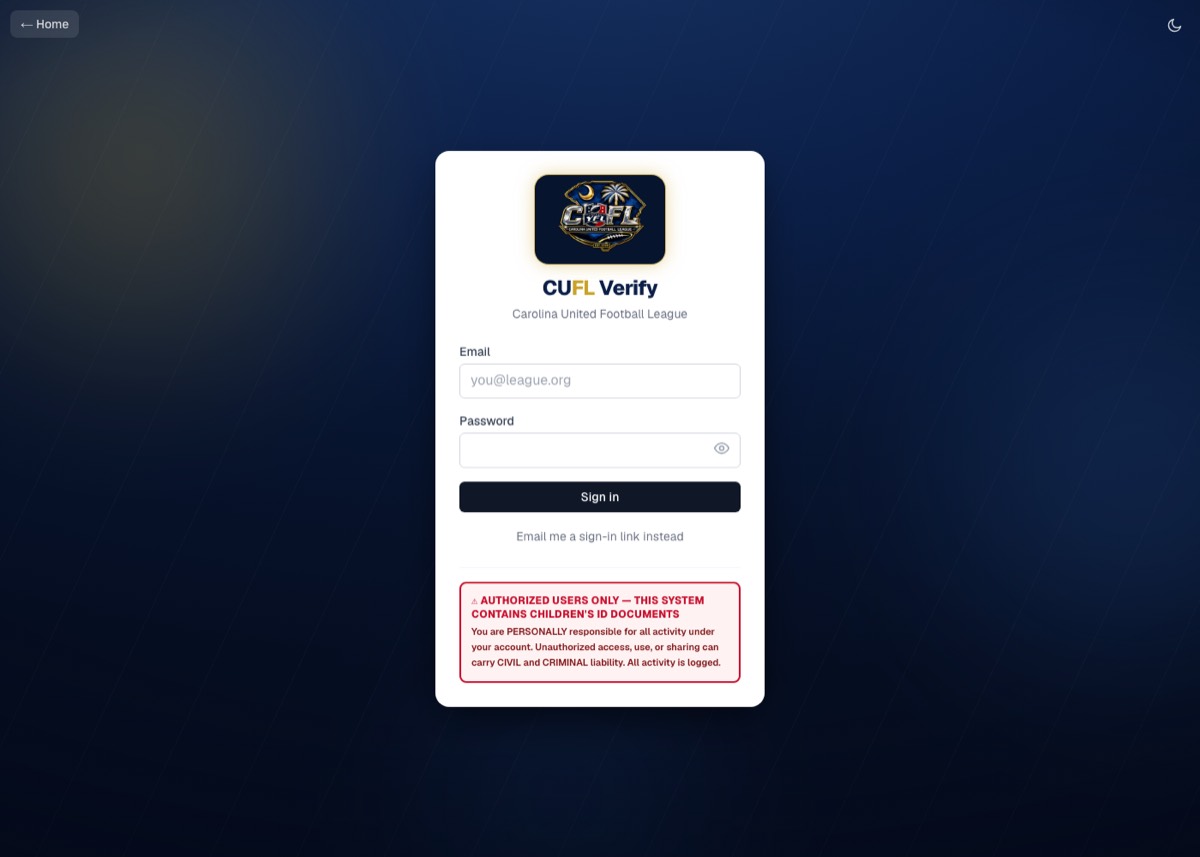
app.cufl-id.com
The CUFL Verify sign-in screen, with an authorized-users-only warning

The screenshot stops at the sign-in screen on purpose. Everything past it is children's identification.

LiveYouth football league · South Carolina

CUFL Verify

Proving every kid on the field is the kid on the roster.

Age and identity checks in youth sports ran on paper, group texts, and a binder somebody left in a truck. On game day nobody could answer a challenge quickly, and the documents that proved it were photocopies floating around a parking lot.

  • Scan a team's QR code and get the player's photo and full name on screen instantly
  • Game-day roll-call built for a coach standing on a sideline in the sun
  • ID documents locked to league administrators — a coach never sees them
  • Every look-up logged, with an authorized-use warning that names the stakes
Open CUFL Verify
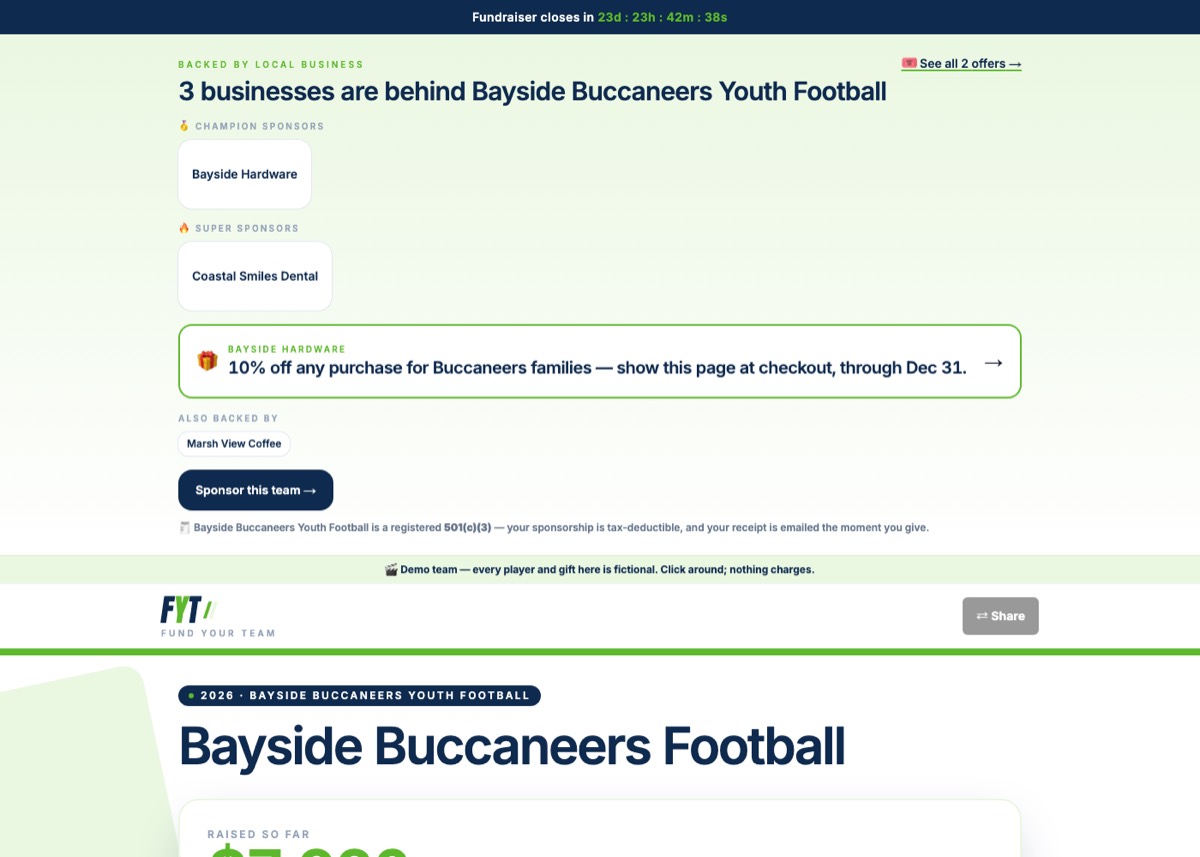
fundyourteam.vercel.app
A Fund Your Team fundraiser page for the fictional Bayside Buccaneers demo team

Shown here on the built-in demo team — every player and gift on this screen is fictional.

LiveSports fundraising · live on real payments

Fund Your Team

Youth sports fundraising without the order forms.

The catalog fundraiser is a bad deal for everyone in it. Families sell candy bars door to door, a third-party company keeps most of the money, and the team waits weeks to see any of it.

  • A personal page per player, shareable by text in one tap
  • Card payments that land in the team's own Stripe account, not ours
  • Automatic 501(c)(3) tax receipts under the organization's own letterhead
  • A digital coupon book that gives local sponsors something better than a banner
Open Fund Your Team
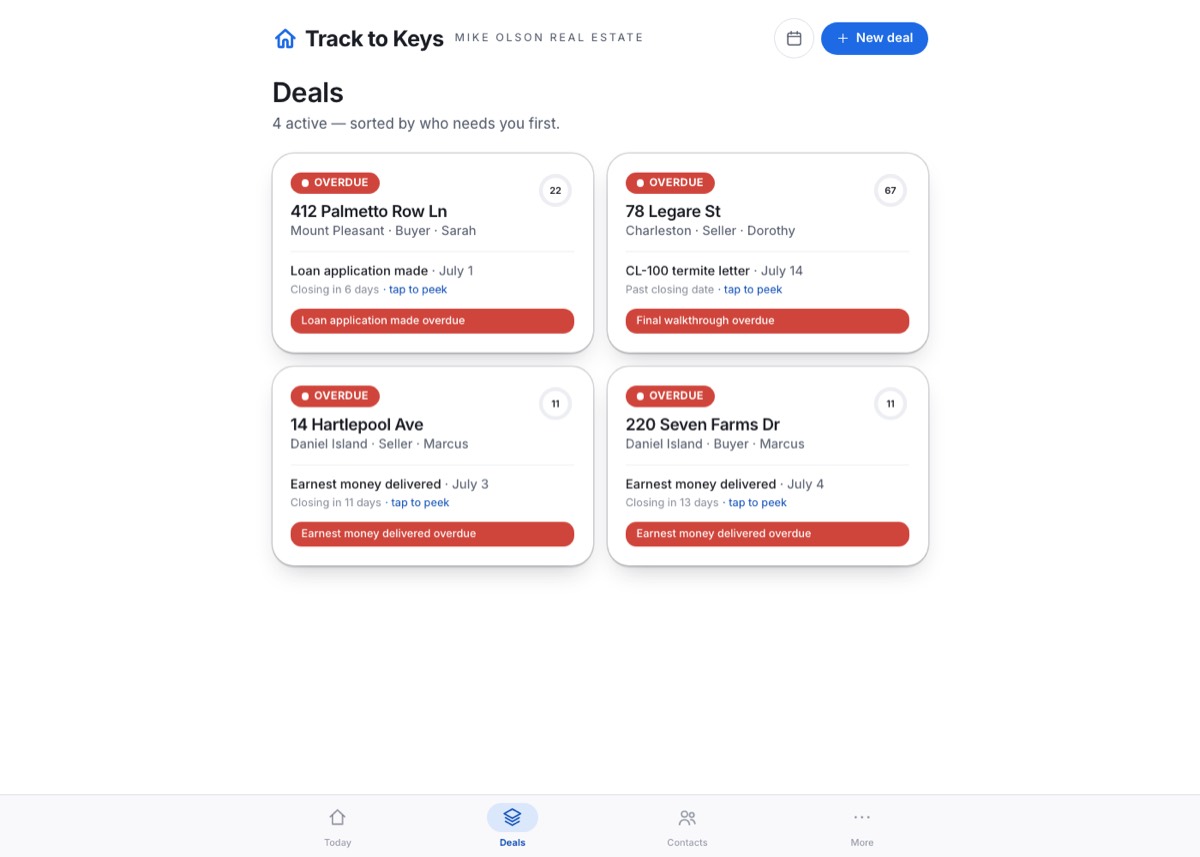
tracktokeys.vercel.app
The Track to Keys deals board, showing four active deals with overdue milestones flagged

Running on a seeded demo agency — the names and addresses on this screen are invented.

LiveReal estate · South Carolina contracts

Track to Keys

Every deadline in a contract, watching itself.

A residential contract hides a dozen dated obligations, and missing one costs real money. Agents track them across a CRM, a paper calendar, and memory — then find out something lapsed when the other side calls.

  • Deadlines generated from the contract's own dates, not typed in by hand
  • A board that sorts by who needs you first and flags what has gone past due
  • A client-facing view so buyers and sellers stop asking what happens next
  • Printable deal summaries for the file
Open Track to Keys
LiveMarket analysis · Johns Island

The Stonoview Index

Eleven years of one neighborhood, told straight.

A neighborhood market report usually means a twelve-month snapshot and a pleasant conclusion. Twelve months is too short a window to see a trend turn, so the report says nothing a seller could act on.

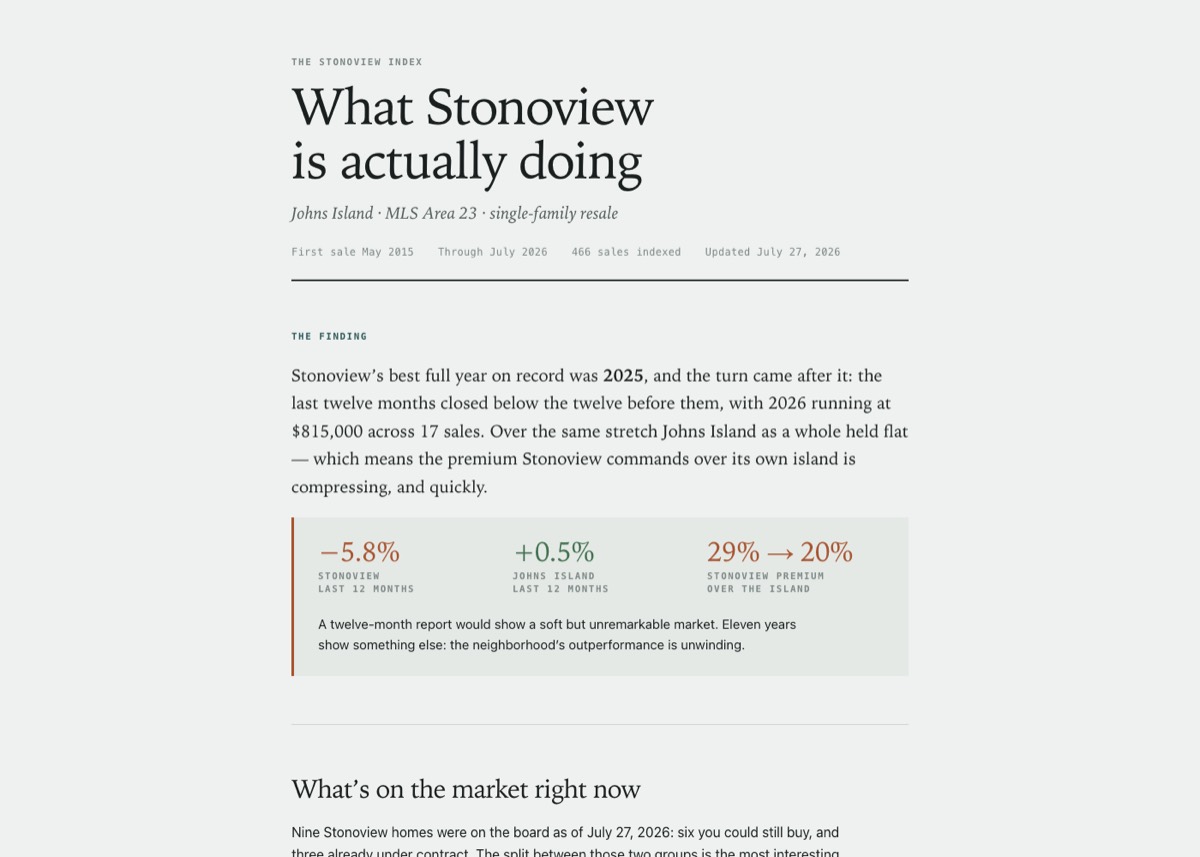
  • 466 indexed sales going back to 2015, not a rolling twelve months
  • The neighborhood measured against its own island, so a premium can be shown compressing
  • A written finding at the top — the number, then what it means
  • Built to run on a static host at no ongoing cost
Open The Stonoview Index

What they have in common

Four different industries, one way of working.

Built around one real workflow

Each of these started as somebody describing a specific headache out loud — not a feature list, and not a category of software. That is why none of them has a settings page nobody opens.

The money stays with the client

Fund Your Team charges cards into the team’s own Stripe account. The Stonoview Index runs static so it costs nothing to keep online. Cost to operate is a design decision, made before the build.

Privacy designed in, not bolted on

CUFL Verify keeps children’s ID documents away from coaches. Fund Your Team keeps kids’ full names off public share cards. Both rules were set before the first screen.

Run in production, by us

These are not handoffs. They get watched, fixed, and extended — which is the only way you find out what a thing actually needed.

The question nobody has checked

When a customer asks an AI for a recommendation, does your name come up?

Most business owners have never once checked. It is worth checking, because the answer is either “yes” or it is nothing at all — and unlike Google, there is no second page to be on.

A Google search

Ten results, and more behind them. Being the eighth-best answer still puts you on the page. People scroll, compare, and click something below the fold every day.

The same question, asked to an AI

One answer. Two or three businesses named, in a sentence, with no list underneath. You are either one of those names or you were never in the conversation — and the customer never learns you exist to go looking.

37%

of consumers now start a search with an AI tool rather than Google.

51%

of B2B software buyers begin research with an AI chatbot more often than with a search engine.

~90%

of search traffic still runs through traditional search engines — which is exactly why this is an AND, not a switch.

SEO is being findable

Getting your business to show up in a list of results a person reads and chooses from. Decades old, still where the majority of traffic comes from, and still worth doing well.

GEO is being quotable

Generative engine optimization: making your business easy for an AI to read, understand, trust, and repeat out loud. Clear facts in plain language, stated where a model can actually find them — your own pages, and everywhere else that talks about you.

Nobody has to panic about this. The businesses that get named are usually not the biggest ones — they are the ones whose information is clear, current, and consistent enough to be repeated confidently. That is fixable work, and it is a great deal cheaper to do now than to notice in two years that the calls stopped coming and nobody can tell you why.

Get a free evaluation →We’ll tell you where you stand in both. No charge, no pitch.

Sources: Search Engine Land (37% of consumers starting with AI); Orbit Media AI-Search Adoption Survey and search-engine market-share tracking (B2B research behaviour and traditional-search share). Figures move quickly; treat them as the shape of the shift, not a precise reading.

Yours is the fifth one.

Every project above started the same way — somebody explained what they run and where it hurts. Tell us yours and we’ll come back with what we’d build for it.